Mars has two moons, Phobos and Deimos. Both Mars moons are small and tidally locked, so each always shows the same face to Mars. Phobos is about 27 kilometers long at its widest, and Deimos is about 15 kilometers. Scientists still disagree about where they came from. One idea is that Mars captured them as asteroids. The other is that they formed from debris after a giant impact on Mars.
That origin question is an objective of Martian Moons eXploration (MMX). The Japan Aerospace Exploration Agency (JAXA) launched MMX on October 19, 2026 Coordinated Universal Time (UTC). The plan is to land on Phobos, collect a sample, and bring it back to Earth in 2031.
The Two Mars Moons, Phobos and Deimos
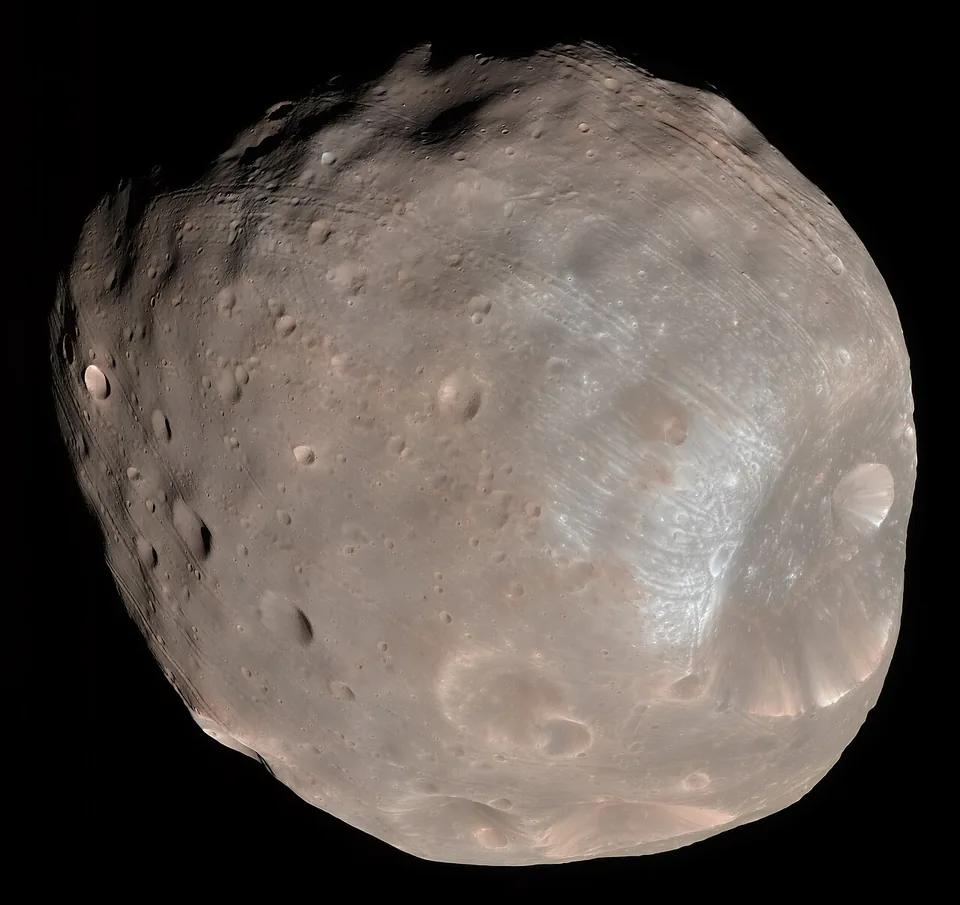
Mars has two moons, Phobos and Deimos, according to the Mars moons overview from the National Aeronautics and Space Administration (NASA). Phobos is the larger and closer of the two, measuring about 27 by 22 by 18 kilometers. Deimos measures about 15 by 12 by 11 kilometers.
The table below collects figures from NASA and from the table of satellite orbits kept by the Jet Propulsion Laboratory (JPL). Where sources give slightly different numbers, both are shown.
| Fact | Phobos | Deimos |
|---|---|---|
| Dimensions (NASA) | 27 × 22 × 18 km (17 × 14 × 11 miles) | 15 × 12 × 11 km (9 × 7 × 6.8 miles) |
| Mean radius (JPL) | 11.08 km | 6.2 km |
| Distance from the center of Mars | 9,375 to 9,377 km | 23,457 to 23,460 km |
| Height above the Martian surface | About 6,000 km (3,700 miles) | Not given in the cited sources |
| Time for one orbit | 7 hours 39 minutes (0.3187 days) | About 30 hours (1.2625 days) |
| Mean density (JPL) | 1.872 g/cm³ | 1.471 g/cm³ |
| Discovered | August 17, 1877 | August 11 or 12, 1877 (sources differ) |
The orbit distances come from two sources. JPL’s orbit table puts Phobos 9,375 km from the center of Mars and Deimos 23,457 km. A report from the National Academies of Sciences, Engineering, and Medicine gives 9,377 km and 23,460 km.
The orbit periods agree once you convert units. JPL’s 1.2625 days for Deimos is 1.2625 × 24 = 30.3 hours, which matches NASA’s “about 30 hours.” JPL’s 0.3187 days for Phobos is 7.65 hours, or 7 hours and 39 minutes.
Size figures vary between sources. JPL’s physical parameters table lists a mean radius of 11.08 km for Phobos. The National Academies report describes Phobos as roughly 22 km in diameter and Deimos as roughly 12 km. NASA’s Planetary Data System catalog entry for Phobos lists its radius as 14 by 10 km.
Phobos, the Larger and Closer Moon
Phobos orbits about 6,000 kilometers above the Martian surface. According to NASA’s Astronomy Picture of the Day entry on Phobos, that makes it closer to its planet than any other moon in the Solar System. It goes around Mars in 7 hours and 39 minutes, which NASA describes as three times a day.
Phobos orbits faster than Mars spins. As a result, it rises above the western horizon twice in each Martian day, so an observer on Mars would look west to watch it rise. NASA also notes that Phobos is so close to Mars that it cannot always be seen from some locations on the planet.
Phobos orbits in the same direction Mars rotates, on a nearly circular path: JPL gives an eccentricity of 0.015 and a tilt of 1.1 degrees. The moon is tidally locked, so the same face always points toward Mars.
The NASA Phobos page says the surface appears to be C-type rock. Surface temperatures range from a high of -4°C (25°F) to a low of -112°C (-170°F). A NASA article on Phobos slowly falling apart says the interior may be a loosely held rubble pile under a layer of loose surface material, called regolith, about 100 meters thick.
Stickney Crater
Stickney is the largest feature on Phobos, according to a NASA Photojournal image of Phobos. The NASA Phobos page gives two widths for it, 9 kilometers (5.6 miles) and about 9.7 kilometers (6 miles). The same page says Stickney covers about half the moon’s surface, and that Mars Global Surveyor imaged the crater.
Grooves Across Phobos
Grooves and chains of craters cross the surface of Phobos, and scientists disagree on what made them. Three explanations appear in NASA sources:
- Impact fractures. The grooves were long thought to be cracks from the impact that created Stickney.
- Tidal stretch marks. Terry Hurford of NASA says the pull of Mars deforms Phobos and produces the grooves. He notes that they radiate from a point near Stickney rather than from the crater itself.
- Debris from Mars. The NASA Photojournal caption cites studies from the European Space Agency (ESA) suggesting the grooves are unrelated to Stickney. In that view, rock blasted off Mars by impacts later struck Phobos.
The Inward Spiral
Phobos is moving closer to Mars, but sources give slightly different rates. The NASA Phobos page says 1.8 meters (6 feet) every hundred years. The NASA falling-apart article says about 2 meters (6.6 feet) per century.
The timeline for the end also varies:
- The NASA Phobos page says it will crash into Mars in 50 million years or break up into a ring.
- The NASA falling-apart article expects it to be pulled apart in 30 to 50 million years.
- The National Academies report gives a time scale of 10 to 100 million years.
All three sources agree that Phobos will not last forever. They differ on how long it has and whether it ends as a crash or a ring.
Deimos, the Smaller Outer Moon
Deimos is the smaller of the two Mars moons. It orbits about 23,457 kilometers from the center of Mars and takes about 30 hours to go around once. The NASA Deimos page gives its size as 15 by 12 by 11 kilometers. JPL lists its orbit as circular, with a tilt of 1.8 degrees.
Deimos looks smoother than Phobos because some of its craters are partly filled in. It has none of the grooves and ridges found on Phobos. NASA’s moons overview describes it as dark and reddish, and smooth except for its most recent craters.
The craters on Deimos are small. The largest is about 2.3 kilometers (1.4 miles) across, roughly one-fifth the size of Stickney on Phobos. Most are smaller than 2.5 kilometers.
Loose regolith on Deimos reaches about 100 meters deep. NASA describes the moon as a dark body with C-type surface material, similar to asteroids in the outer asteroid belt. The asteroid mining explainer covers asteroids as a separate topic.
Discovery and Names of Phobos and Deimos
Asaph Hall discovered both moons in August 1877. According to Astronomy magazine’s account of the discovery, he worked at the U.S. Naval Observatory in Washington, D.C., using its 26-inch Clark refractor. The Linda Hall Library profile of Asaph Hall says that telescope was the largest in the world, and that Hall had joined the observatory as an assistant in 1862.
NASA dates the discovery of Phobos to August 17, 1877. The Deimos date depends on the source:
- NASA gives August 11, 1877.
- Astronomy magazine says Hall spotted a moon on August 11 but lost sight of it, then confirmed Deimos the next evening.
- The Linda Hall Library says Hall first glimpsed the smaller moon on August 11, then relocated it and found the larger moon on August 17.
The names come from Greek myth. Phobos and Deimos were sons of Ares, the Greek god who matches the Roman Mars. Phobos means fear and Deimos means dread, and the two are brothers. The Linda Hall Library says Hall named them after the two sons of Mars who stood for Fear and Terror.
Where the Mars Moons Came From
The origin of Phobos and Deimos is unresolved, and two main ideas compete. The first is capture. Mars may have pulled in passing asteroids with its gravity. The second is a giant impact, in which something large hit early Mars and threw material into orbit, which then gathered into moons.
NASA’s moons overview says both moons are thought to be captured asteroids, or debris from early in the formation of the Solar System. Tom Statler of NASA laid out both options in an article on NASA’s role in MMX. He said the moons “may be the remains of a massive impact on Mars” or “ancient asteroids that were captured by Mars’ gravity billions of years ago.” The National Academies report describes the same split between capture and formation from a disk of debris after a giant impact.
The evidence points in both directions. Kuramoto Kiyoshi, the lead scientist on MMX, notes that the moons closely resemble carbonaceous asteroids. Spaceflight Now reported that data from the Emirates Mars Mission, called Hope, presented in April 2023, suggest the moons may have formed from impact debris. Scientists found no strong signs of carbon minerals on Deimos, so it may not be a D-type asteroid.
JAXA lists uncovering the origin of the Martian moons as an objective for MMX, which will bring Phobos material to Earth.
Missions to Phobos and Deimos
Several spacecraft have imaged or flown close to the Mars moons. The table summarizes the missions with published dates.
| Mission | Date | What it did |
|---|---|---|
| Phobos 1 | Launched July 7, 1988 | Contact lost September 1, 1988, before reaching Mars |
| Phobos 2 | Launched July 12, 1988; Mars orbit January 29, 1989 | Took television images of Phobos; contact lost March 27, 1989 |
| Mars Reconnaissance Orbiter (MRO) | March 23, 2008 | Two images of Phobos from about 6,800 km |
| MRO | February 21, 2009 | Imaged Deimos |
| Mars Express (ESA) | March 3, 2010 | Close flyby to measure Phobos’s gravity field |
| Mars Express (ESA) | December 29, 2013 | Flyby about 45 km above Phobos |
| Hope (Emirates Mars Mission) | March 10, 2023 | Passed about 100 km from Deimos |
According to the Phobos 2 mission catalog, Phobos 2 lost contact “just before the third stage of the mission.” Its plan had called for an approach as close as about 50 meters to Phobos. The catalog does not say that approach happened.
The High Resolution Imaging Science Experiment (HiRISE) camera on MRO took its two Phobos images 10 minutes apart, at a resolution of about 20 meters. For the 2010 Mars Express flyby, ESA’s preview of the closest approach estimated about 50 km above the surface. The ESA preview of the 2013 flyby says that pass aimed to measure the moon’s gravity, mass, and density.
MMX, the Phobos Sample-Return Mission
MMX is planned to land on Phobos and return a sample. According to the JAXA launch announcement, MMX lifted off at 04:41:03 Japan Standard Time (JST) on October 20, 2026, which was October 19 in UTC. It flew on H3 Launch Vehicle Flight No. 10 from Tanegashima Space Center. JAXA reported that the rocket flew as planned and released MMX about 71 minutes and 13 seconds after liftoff.
The JAXA MMX mission site describes Phobos as “a Martian moon that has never been explored.” The plan has four parts:
- Enter a quasi-satellite orbit around Phobos.
- Collect a sample through two soft landings.
- Observe Deimos near the end of the mission.
- Return more than 10 grams of material to Earth in 2031, with the capsule recovered in Australia.
NASA’s article on MMX says the spacecraft arrives at Mars in 2027, with sample collection no earlier than 2028. NASA supplies a sampler called P-Sampler, mounted on a landing leg to collect ground material. NASA will curate about 15% of the returned sample. The NASA MMX mission page also covers the mission schedule.
MMX is part of the wider Japanese space program. For sample-return plans aimed at Mars itself, see the Mars Sample Return explainer. To follow the Mars moons as MMX heads for Phobos, read the MMX mission explainer for the spacecraft, its instruments, and its timeline.