The H3 rocket is Japan’s flagship launch vehicle. The Japan Aerospace Exploration Agency (JAXA) developed it with Mitsubishi Heavy Industries (MHI) as prime contractor, to replace the H-IIA at a lower launch price. Of its 10 flights through October 2026, eight succeeded and two failed. Test Flight No. 1 failed in March 2023 when its second-stage engine did not ignite. Flight No. 8 failed in December 2025; JAXA’s investigation judged it very likely that a satellite mounting adapter broke during flight.
The most recent launch, Flight No. 10, sent JAXA’s Martian Moons eXploration (MMX) spacecraft toward the moons of Mars on 20 October 2026, Japan Standard Time (JST). JAXA’s H3 project page describes the aim as ‘easy-to-use rockets’ with flexibility, high reliability and good cost performance. MHI’s launch vehicle page calls the H3 ‘Japan’s flagship rocket jointly developed by JAXA and MHI.’
What the H3 Rocket Is
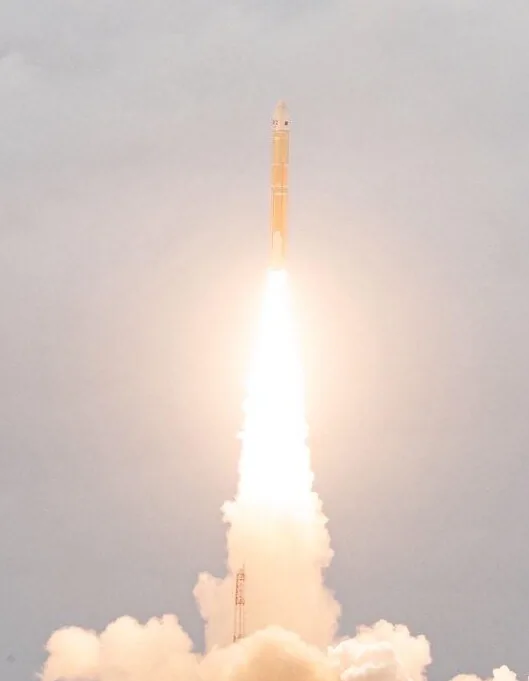
The H3 is Japan’s new mainstay launch vehicle, and JAXA’s rocket site names it the successor to the H-IIA. JAXA leads development. Its May 2026 development status document names MHI as prime contractor for both the rocket system and the engine system.
That document also lists the partner companies behind specific parts:
- Japan Aviation Electronics for the inertial sensor
- Mitsubishi Electric Software for the guidance software
- NEC Space Technologies for the autonomous flight safety computer
- IHI for the turbopumps
- IHI Aerospace for the gas jets and solid rocket boosters
The H3 project started in April 2014, and JAXA announced the name “H3” on 2 July 2015. Citing Japan’s Space Policy Committee, JAXA set three goals: independent access to space for government satellites, keeping Japan’s solid-rocket technology, and a launch service that competes internationally on reliability and price. JAXA also wants the H3 to be a rocket “used from around the world” and “used for 20 years.”
How the Configuration Names Work
Each H3 name spells out its hardware. The first digit is the number of LE-9 main engines, and the second digit is the number of SRB-3 solid rocket boosters. A trailing letter gives the fairing: short (S), long (L) or wide (W).
| Configuration | LE-9 engines | SRB-3 boosters | What JAXA says about it |
|---|---|---|---|
| H3-30 | 3 | 0 | The light configuration, mainly for low Earth orbit (LEO); first flew on Flight No. 6 |
| H3-22 | 2 | 2 | Flew Test Flight No. 1 through Flight No. 5, and Flight No. 8 |
| H3-24 | 2 | 4 | JAXA names H3-24L the standard H3; H3-24W was built for the HTV-X cargo spacecraft |
JAXA says Flight No. 6 was the first large liquid rocket in Japan to lift off on liquid engines alone, and that it completed the full H3 lineup. On the H3-30, a hold-down system keeps the rocket on its mobile launcher until all three LE-9 engines are confirmed running.
Engines and Boosters
Both H3 stages use expander bleed cycle engines. The first stage carries two or three LE-9 engines, a design that draws on JAXA’s LE-5 engine work and includes 3D-printed parts. Each LE-9 is rated at 1,471 kilonewtons (kN) of vacuum thrust, with a specific impulse of 422 seconds.
The second stage uses one LE-5B-3 engine, rated at 137 kN and 448 seconds. Each SRB-3 booster is 2.5 meters wide, gives 2,300 kN of vacuum thrust, and shares a common component with the first-stage motor of Japan’s Epsilon rocket. For the basics of how stages and boosters work together, see how rocket launches work.
Flights 3 to 8 flew an interim engine version called LE-9 Type 1A. JAXA is developing Type 2 as the permanent fix for turbine blade vibration in the liquid-hydrogen turbopump. Type 2 also uses 3D-printed injectors, which merge a part once built from more than 1,000 pieces into one, and its qualification testing began at the end of March 2026.
Size and Mass
The H3 stands about 63 meters tall as an H3-24L, about 57 meters as an H3-30S or H3-22S, and about 64 meters as an H3-24W. Sources differ slightly on core diameter and gross mass, measured in metric tons (t).
| Measure | JAXA | Other sources |
|---|---|---|
| Core diameter | 5.2 m | 5.27 m (Wikipedia) |
| H3-24L gross mass | 575 t (specs page); 574 t without payload (H3 project page) | 575 t (MHI) |
| H3-30 gross mass | Not given | 270 t for H3-30S (MHI); 271 t (Wikipedia) |
The JAXA figures come from the JAXA H3 specifications page and JAXA’s H3 project page. The 5.27-meter diameter and 271-ton mass come from the same Wikipedia article. MHI also lists the H3-22L at 420 t and the H3-22S at 419 t.
Launch Site
Every H3 lifts off from the Yoshinobu Launch Complex at JAXA’s Tanegashima Space Center, as JAXA’s Test Flight No. 2 schedule release states. JAXA refurbished Launch Pad 2 for the H3, built a new mobile launcher called ML5, and modified the vehicle assembly building. It also moved the launch control center to the Takesaki area so the countdown runs remotely, and it expects to launch about six H3s a year.
H3 Flight Record and Both Failures
The H3 has flown 10 times through October 2026, with eight successes and two failures: Test Flight No. 1 (TF1) and Flight No. 8 (F8). Flight numbers belong to vehicles and do not follow launch order. Flight No. 6 actually flew after Flights No. 7 and No. 8, a sequence shown on JAXA’s launch records page.
Times below are JST, which is Coordinated Universal Time (UTC) plus nine hours.
| Launch order | Flight | Date and time (JST) | Configuration | Payload | Outcome |
|---|---|---|---|---|---|
| 1 | TF1 | 7 Mar 2023, 10:37:55 | H3-22S | ALOS-3 “DAICHI-3” | Failure |
| 2 | TF2 | 17 Feb 2024, 09:22:55 | H3-22S | VEP-4, CE-SAT-IE, TIRSAT | Success |
| 3 | F3 | 1 Jul 2024, 12:06:42 | H3-22S | ALOS-4 “DAICHI-4” | Success |
| 4 | F4 | 4 Nov 2024, 15:48:00 | H3-22S | X-band defense communication satellite-3 (“KIRAMEKI-3”) | Success |
| 5 | F5 | 2 Feb 2025, 17:30:00 | H3-22S | QZS-6 “MICHIBIKI No. 6” | Success |
| 6 | F7 | 26 Oct 2025, 09:00:15 | H3-24W | HTV-X1 | Success |
| 7 | F8 | 22 Dec 2025, 10:51:30 | H3-22S | QZS-5 “MICHIBIKI No. 5” | Failure |
| 8 | F6 | 12 Jun 2026, 09:53:59 | H3-30S | VEP-5 and six small satellites | Success |
| 9 | F9 | 11 Aug 2026, 04:23:31 | Not published by JAXA | QZS-7 “MICHIBIKI No. 7” | Success |
| 10 | F10 | 20 Oct 2026, 04:41:03 | Not published by JAXA | MMX | Success |
Wikipedia lists F9 as an H3-22S and F10 as an H3-24L, but JAXA and MHI have not published either configuration. In UTC, F9 launched on 10 August 2026 at 19:23:31 and F10 on 19 October 2026 at 19:41:03, so some sources give a different day. Between the two failures, the H3 flew five successes in a row: four H3-22 flights from TF2 to F5, then the first H3-24 success on F7.
Test Flight No. 1 Failure in March 2023
TF1 failed because its second-stage engine did not ignite, so the rocket could not put the ALOS-3 (Advanced Land Observing Satellite 3) into orbit. The rocket flew as planned through stage separation. JAXA sent a destruct command at 10:51:50 JST, about 14 minutes after liftoff. An earlier attempt on 17 February 2023 had been cancelled.
In August 2023, JAXA grouped the cause into three faults:
- A minor short circuit inside a component called the exciter became a full short.
- An overcurrent occurred when the exciter was energized.
- An overcurrent inside the A-system of the Stage 2 Propulsion System Controller (PSC2) spread to its B-system.
JAXA fixed the exciter and PSC2 to address all three. A document from the Ministry of Education, Culture, Sports, Science and Technology (MEXT) dated October 2023 gives the direct cause as overcurrent downstream of the second-stage propulsion controllers. JAXA then flew TF2 with LE-9 Type 1A and a dummy payload, and TF2 reached its planned orbit on 17 February 2024.
Flight No. 8 Failure in December 2025
F8 failed when the second-stage engine’s second ignition did not start normally and shut down early, JAXA reported. As a result, the QZS-5 (Quasi-Zenith Satellite 5) missed its planned orbit. An attempt on 17 December 2025 had been cancelled before liftoff over “an uncertain incident” in the ground facilities.
JAXA’s investigation pointed to the payload support structure (PSS), the adapter that holds the satellite on the rocket. In April 2026, JAXA judged it “very likely” that delamination between splices in the PSS formed during manufacturing. That delamination then grew under the shock of fairing separation and broke the structure, while JAXA said other causes on its fault tree cannot yet be fully ruled out.
The direct cause was lost strength where the carbon-fiber-reinforced plastic (CFRP) skin separated between splices. A MEXT subcommittee page hosts the interim report dated 22 April 2026. The Japan Science and Technology Agency’s Science Portal summary says the PSS buckled onto the second stage’s liquid hydrogen tank and broke its piping, which dropped tank pressure and made combustion abnormal.
SatNews reported in January 2026 that JAXA had already linked the failure to the fairing separation phase. JAXA’s fix comes in two forms. One is a repair that cuts out the delaminated skin and honeycomb, fills the gap with resin and adds doublers, and the other is a PSS whose four panels are bolted together.
Satellite-carrying flights will use the bolted PSS. Satellite fairings are made by a similar process, so JAXA is inspecting and repairing the splice areas on every fairing for now. Science Portal reports that the HTV-X adapter uses a different design and is not affected.
Flight No. 6 and the Return to Flight
Flight No. 6 returned the H3 to flight on 12 June 2026, and JAXA reported that its second stage reached the planned orbit. It was also the first H3-30. It flew a repaired PSS that JAXA had verified for strength and used to gather extra flight data.
F6 carried VEP-5, which stays on the second stage, plus six small satellites bound for sun-synchronous orbit (SSO). Its own delay came from a first-stage tank pressurization shortfall found in a July 2025 test firing. JAXA traced the shortfall to the 30-configuration layout and confirmed the fix in a second firing in March 2026.
How Much the H3 Rocket Can Carry
JAXA and MHI publish one capability figure for each orbit type: 4 t or more to a 500-kilometer SSO, and 6.5 t or more to geostationary transfer orbit (GTO). JAXA defines that GTO with a delta-v (velocity change) of 1,500 meters per second. JAXA says this GTO capability exceeds that of the H-IIA and H-IIB.
Neither JAXA nor MHI breaks those figures down by configuration, and neither publishes a LEO figure. Wikipedia lists per-configuration numbers, including a LEO figure for the H3-24, but those do not come from JAXA or MHI. In May 2026, JAXA said it expects the H3-22 and H3-24 to reach their target capability by releasing system margins based on flight data, reviewing error sources, and moving to LE-9 Type 2.
What an H3 Rocket Launch Costs
JAXA’s cost target is about ¥5 billion per vehicle for the light configuration, which has no solid boosters. JAXA’s TF1 overview slides describe that as about half the H-IIA’s price, at the steady operation stage and under certain conditions. By JAXA’s own ratio, the H-IIA comparison point works out to about ¥10 billion (¥5 billion × 2).
In May 2026, JAXA said it expects the H3-22 and H3-24 to also meet the half-of-H-IIA price goal in steady operation. Those conditions assume the prices and exchange rates from when development started. JAXA notes that both have changed a lot in more than 10 years, and that real prices need to reflect those changes.
Wikipedia lists the target as “¥5 billion (2023)” for the H3-30, a framing JAXA does not use. JAXA and MHI publish no list price for an H3-22 or H3-24 launch. From Flight No. 4 onward, the customer’s launch service contract sits with MHI, which our Mitsubishi Heavy Industries stock explainer covers from the investor side.
H3 and the MMX Launch
Flight No. 10 launched the MMX spacecraft at 04:41:03 JST on 20 October 2026, which was 19:41:03 UTC on 19 October. JAXA reported that the rocket flew as planned and that MMX separated into its planned orbit about 71 minutes 13 seconds after liftoff. Separation took about 16 minutes 43 seconds on TF2, about 16 minutes 4 seconds on F6, and about 14 minutes 4 seconds on F7.
For planetary missions like MMX, the H3 relays its flight data through the National Aeronautics and Space Administration’s (NASA) Tracking and Data Relay Satellite (TDRS) system. The H3 first demonstrated that relay on F7. JAXA’s F10 schedule release named the Yoshinobu Launch Complex as the site, and JAXA and MHI have not published F10’s configuration, which Wikipedia gives as H3-24L.
The spacecraft’s goals and route are in our MMX mission explainer. The two moons it is headed for are covered in Mars’s moons explained.
From H-IIA to H3
The H3 replaced the H-IIA, which flew from 2001 to 2025. The H-IIA’s final flight, F50, lifted off at 1:33:03 a.m. JST on 29 June 2025 carrying the GOSAT-GW “IBUKI GW” satellite. MHI’s live report on that flight called it “a beautiful final launch.”
The Associated Press (AP) reported, in a story republished by News4JAX, that the H-IIA had 49 earlier flights with a 98% success record and one failure, in 2003. JAXA’s records list that failure as H-IIA F6 on 29 November 2003, destroyed by a command from the ground. JAXA and MHI have not published the 50-flight, one-failure total themselves.
MHI took over H-IIA launch transport service in 2007, and JAXA, the launch operator under Japan’s Space Activities Act, plans a staged move to private-led launches. A 2018 MHI release named Inmarsat as the first commercial customer to order an H3 and targeted commercial service for 2022, while the first flight came in 2023.
For how the H3 sits among other medium-lift rockets, see our Falcon 9 alternatives guide. Japan’s wider program is covered in our Japan space program overview, and our launch vehicles explainer covers rocket classes in general. To track the next H3 rocket launch and its result, read JAXA’s H3 press release index.