Mitsubishi Heavy Industries stock trades on the Prime market of the Tokyo Stock Exchange under securities code 7011. In the United States it appears over the counter (OTC) as MHVYF, which represents the ordinary shares, and as MHVIY, an unsponsored American depositary receipt (ADR).
Mitsubishi Heavy Industries (MHI) is a Tokyo-based industrial group founded in 1884. It reports four business segments covering energy, plants and infrastructure, logistics and drive systems, and aircraft, defense and space, the last of which includes Japan’s H3 rocket.
Where Mitsubishi Heavy Industries Stock Trades and How to Buy It
To buy Mitsubishi Heavy Industries stock, you need a brokerage account that reaches either the Tokyo market, where MHI trades as 7011, or the US over-the-counter market, where it trades as MHVYF and MHVIY. The two OTC symbols are different securities, so pick the symbol before you pick the broker.
MHI’s stock information page gives the securities code as 7011 and the trading unit as 100 shares. It also lists 3,373,647,810 total shares issued. MHI’s Corporate Governance Report, updated June 26, 2026, names four listings: Tokyo (Prime), Nagoya (Premier), Sapporo (Existing Market) and Fukuoka (Existing Market).
| Market | Ticker or code | What it is |
|---|---|---|
| Tokyo Stock Exchange (Prime) | 7011 | MHI ordinary shares, traded in 100-share units |
| Nagoya (Premier), Sapporo, Fukuoka | 7011 | The same ordinary shares on these exchanges |
| US over the counter | MHVYF | Ordinary shares, carrying the Tokyo shares’ ISIN per GuruFocus |
| US over the counter | MHVIY | Unsponsored ADR, BNY as depositary, 2 ADRs per ordinary share per Deutsche Bank |
MHVYF and MHVIY
MHVYF is the ordinary share line, and MHVIY is the ADR. GuruFocus lists MHVYF as “Ordinary Shares” with international securities identification number (ISIN) JP3900000005, the same identifier as the Tokyo-listed stock. Seeking Alpha labels the tier “Pink Limited Info,” and Benzinga lists it as OTCPK. Both are third-party sources, and the OTC Markets page for MHVYF returned “Temporarily Unavailable” when checked for this page.
Deutsche Bank’s depositary receipt directory lists MHVIY as an unsponsored ADR trading OTC, with BNY as depositary and a ratio of 1:2 (one ordinary share to two ADRs). At that ratio, one 100-share Tokyo trading unit equals 200 MHVIY ADRs. Robinhood’s MHVIY page also labels the ADR unsponsored.
The ADR ratio has changed twice, according to BNY notices available only as search-engine snippets. Treat these dates as unverified. A July 2025 BNY notice moved the ratio from one ADR per two shares to one ADR per share, effective August 4, 2025. An April 2026 BNY notice moved it to two ADRs per share, effective May 12, 2026.
Adjust older MHVIY price history by the ratio in force at the time before you compare it with current data.
Broker Access
No named US broker was confirmed for MHVYF or MHVIY. Robinhood has an MHVIY page, but its text confirms only the name and description, so whether the ADR can be traded there is not published. Ask your broker two questions before ordering: does it route orders to the Tokyo Stock Exchange, and does it trade OTC symbols such as MHVYF and MHVIY.
The 2024 Stock Split
MHI split its shares 10-for-1, effective April 1, 2024, according to its February 6, 2024 split announcement. MHI said the purpose was “to lower the bar for investors to purchase the company’s shares.” Its chief financial officer said the split would cut the cost of one 100-share trading unit to about a tenth of its pre-split level. The release did not state a record date.
MHI’s May 2025 dividend release confirms the split and says prior-year figures were adjusted retroactively.
What Kind of Company MHI Is
Mitsubishi Heavy Industries is an industrial manufacturer that reports its business in four segments, ranging from power plants to rockets. The legal name is Mitsubishi Heavy Industries, Ltd. MHI’s company profile gives a foundation date of July 7, 1884, and an establishment date of January 11, 1950.
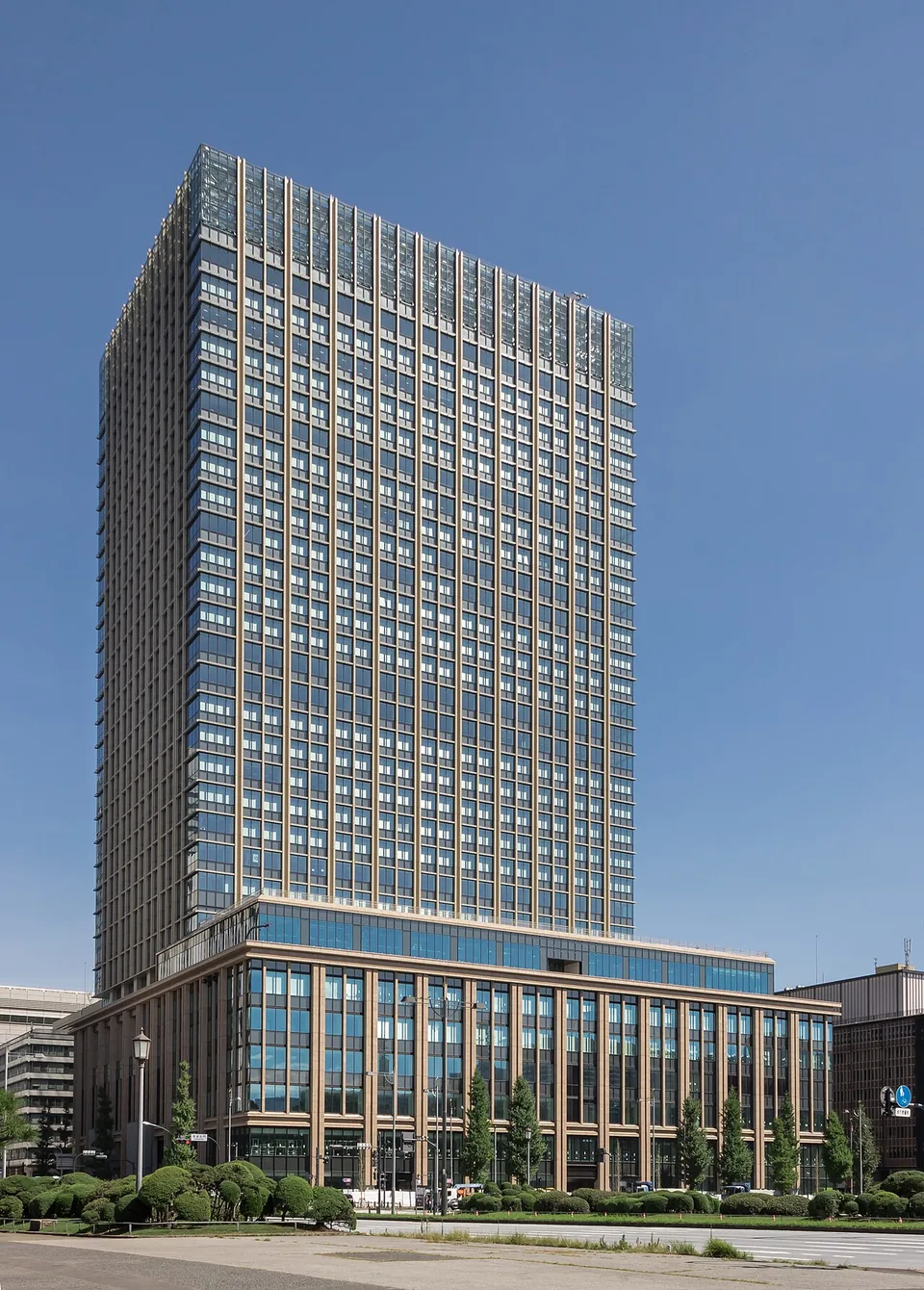
The registered head office is in Marunouchi, Chiyoda-ku, Tokyo. As of March 31, 2026, MHI reported 78,793 consolidated employees, 246 group companies (55 domestic and 191 overseas) and capital of 265.6 billion yen. Eisaku Ito is President and CEO.
MHI’s FY2025 financial results, covering the year ended March 31, 2026, report the following:
- Order intake of 7,653.6 billion yen, up 19.5%.
- Revenue of 4,974.1 billion yen, up 14.1%.
- Profit from business activities of 432.2 billion yen, up 21.8%.
- Profit attributable to owners of the parent of 332.1 billion yen.
Those totals exclude the Mitsubishi Logisnext businesses (now Logisnext Co., Ltd.), which MHI classifies as discontinued operations. MHI restated its FY2024 segment figures on the same basis.
| Segment | Products MHI lists | FY2025 revenue (¥ million) | FY2024 restated (¥ million) | FY2025 segment profit (¥ million) |
|---|---|---|---|---|
| Energy Systems | Thermal, nuclear and wind power systems, aero engines, compressors, marine machinery | 2,062,600 | 1,815,796 | 267,272 |
| Plants & Infrastructure Systems | Metal machinery, commercial ships, transportation systems, chemical plants, environmental systems | 880,893 | 852,112 | 84,106 |
| Logistics, Thermal & Drive Systems | Air-conditioning and refrigeration, engines, turbochargers, automotive thermal systems | 630,826 | 641,035 | 33,066 |
| Aircraft, Defense & Space | Commercial aviation, defense aircraft, missile systems, naval ships, torpedoes, tanks, space systems | 1,393,858 | 1,030,646 | 151,505 |
Segment revenue figures include inter-segment sales. Others contributed 75,994 million yen, Corporate & Eliminations subtracted 70,005 million yen, and consolidated revenue came to 4,974,168 million yen. MHI does not publish each segment’s share of revenue as a percentage.
Aircraft, Defense & Space showed the largest year-on-year change in yen: 1,393,858 minus 1,030,646 equals 363,212 million yen. Energy Systems grew by 246,804 million yen (2,062,600 minus 1,815,796).
Defense and Space Work at MHI
MHI’s defense and space businesses sit together in the Aircraft, Defense & Space segment. MHI’s FY2025 results presentation splits the segment into two main businesses. Defense & Space revenue was 1,144.5 billion yen (FY2024: 827.6 billion), and Commercial Aviation revenue was 249.2 billion yen (FY2024: 203.0 billion).
Defense Programs
Reuters, in a May 2023 report republished by China Daily, called MHI “Japan’s biggest defense contractor,” with military work at “around a tenth of overall revenue” at that time. In November 2023, Reuters reported that MHI expected to double its defence revenue to about 1 trillion yen from the business year starting April 2024.
The FY2025 presentation says Defense & Space revenue rose 40% year over year. It puts the segment’s order backlog at 4,063.2 billion yen, up from 3,514.5 billion. It also says the segment booked an order for an Australian frigate program. Defense & Space order intake was 1,682.6 billion yen, down from 1,876.8 billion in FY2024.
USNI News reported in April 2023 that Japan’s Ministry of Defense (MoD) signed four contracts worth about $2.83 billion with MHI for standoff weapons, including improved Type 12 anti-ship missiles. The upgraded missile’s range varies between sources. Janes gives 200 to 1,000 kilometers, while The Defense Post gives 200 to 900 kilometers, with 1,500 kilometers planned later.
MHI also has a role in the Global Combat Air Programme (GCAP). A Leonardo release from June 2025 says BAE Systems, Leonardo and Japan Aircraft Industrial Enhancement Co., Ltd. (JAIEC) each hold 33.3% of Edgewing, the GCAP joint venture. Edgewing will subcontract aircraft manufacturing and final assembly to BAE Systems, Leonardo and MHI.
MHI’s own JAIEC announcement says JAIEC began operations on July 10, 2024. The Society of Japanese Aerospace Companies (SJAC) is the majority shareholder, and MHI is a minority shareholder. Breaking Defense describes MHI as the prime contractor in Japan for GCAP.
Space and the H3 Rocket
H3 and launch services sit inside the Space systems line of the Aircraft, Defense & Space segment. MHI’s launch vehicles page calls H3 “Japan’s flagship rocket jointly developed by JAXA and MHI,” referring to the Japan Aerospace Exploration Agency (JAXA). A 2018 MHI release describes MHI as primary contractor under JAXA’s leadership, and names Inmarsat as H3’s first commercial customer.
H3’s Test Flight 1 failed in March 2023. MHI’s page says the rocket has had consecutive successful launches since Test Flight 2 in February 2024, though the page carries no as-of date. Our H3 rocket explainer covers the vehicle, and the MMX mission page covers the MMX mission.
The results filing does not break out H3 or launch services revenue. Space revenue is combined with defense in the 1,144.5 billion yen Defense & Space figure, so the rocket’s financial weight inside MHI is not published. For Japan’s wider space effort, see our Japan space program overview.
Japan’s Defense Budget Plan
Japan’s December 16, 2022 Defense Buildup Program puts defense buildup expenditure for FY2023 to FY2027 at approximately ¥43 trillion. It lists the upgraded Type-12 surface-to-ship missile under stand-off defense, without naming MHI.
The same document uses three different figures, and they measure different things:
- About ¥43 trillion in total defense buildup expenditure over the five years.
- About ¥40.5 trillion in total annual defense budgets for FY2023 to FY2027, including about ¥8.9 trillion in FY2027.
- About ¥43.5 trillion in new contract-based (material) expenses.
The National Security Strategy, also from December 2022, says Japan will raise defense and complementary spending to 2% of current gross domestic product (GDP) in FY2027. Jiji Press, via Adnkronos, reported in August 2026 that FY2025 spending including related costs reached about 11 trillion yen, meeting the 2% target two years early. Jiji Press, via Nippon.com, reported that the Defense Ministry plans a record FY2027 budget request of about 8.9 trillion yen.
MHI’s FY2025 presentation charts Japan’s contract-based defense budget, citing the MoD, at 3,838.8 billion yen in FY2022 and 9,082.3 billion yen in FY2023. The chart shows 8,260.7 billion yen for FY2026. These values come from text extraction of a chart, and the year-to-value pairing has not been checked against the PDF.
Japan’s defense spending sits beside the US missile-defense build-out covered in our Golden Dome stocks explainer.
How to Research Mitsubishi Heavy Industries Stock
MHI publishes its results, plans and reports through its own investor relations site, and it files documents on Japan’s EDINET system. The MHI IR Library holds five categories: Financial Results, Medium-Term Business Plan, Briefings by Topic, the MHI REPORT integrated report, and Other Reports and Conference Movie. Results releases sit in the financial results library.
MHI’s EDINET filer code is E02126, as shown on its June 2026 corrected shelf registration statement. MHI filings also appear on the Sapporo Securities Exchange IR portal, including the May 2026 results.
Check these five figures in the filings:
- Segment revenue and profit, compared year over year using the restated FY2024 figures.
- The Aircraft, Defense & Space order backlog, reported at 4,063.2 billion yen in FY2025.
- MHI’s own FY2026 forecast of ¥5.4 trillion in revenue and ¥540 billion in profit from business activities, measured against actual results each quarter.
- Japan’s defense budget requests and the contract-based budget series MHI charts.
- For MHVIY holders, the ADR ratio in force on each date you compare.
MHI’s fiscal year ends March 31, so “FY2025” in MHI filings covers April 2025 through March 2026. MHI’s shareholder registry is administered by Mitsubishi UFJ Trust and Banking Corporation. The shareholder count varies between versions of the same MHI page: 966,050 as of September 30, 2026 on the live page, 520,399 in a search snippet, and 497,778 on an older copy of the stock information page. Major shareholder data was not among the sources for this page.
For comparison, see our pages on ispace stock and Astroscale stock. See also our best space stocks overview and space ETFs guide.
The FY2025 results filing and segment table are the first documents to read on Mitsubishi Heavy Industries stock, and no named US broker has been confirmed to trade 7011, MHVYF or MHVIY.