Hayabusa2 is a Japan Aerospace Exploration Agency (JAXA) spacecraft that brought samples of asteroid Ryugu back to Earth in December 2020, then kept flying. It is on an extended mission called Hayabusa2#. It flew past asteroid (98943) Torifune on 5 July 2026 and is heading for asteroid 1998 KY26, with arrival planned for 2031 after Earth swing-bys in 2027 and 2028.
Hayabusa2 launched on 3 December 2014 and spent 2018 and 2019 at Ryugu. There it released rovers and a lander, touched down twice, and fired an impactor to make an artificial crater. Its return capsule landed in Australia with about 5.4 grams of material; the mission’s minimum requirement was 0.1 gram. Lab teams have since reported water-bearing minerals, 23 kinds of amino acids, and the RNA nucleobase uracil in that material.
Where Hayabusa2 Is Now
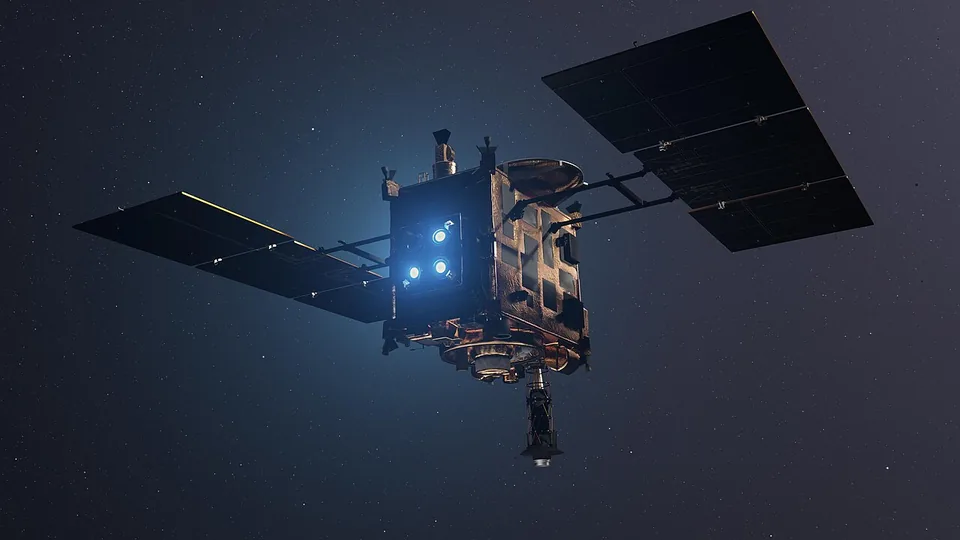
JAXA has published no position or status update newer than its 30 July 2026 flyby releases, so the spacecraft’s current location and distance from Earth are not public. JAXA’s Hayabusa2 project page describes the spacecraft as “in its latter phase of operation under the extended mission.”
JAXA’s 6 July 2026 image release put preliminary closest approach at 18:30 Japan Standard Time (JST) on 5 July and confirmed normal spacecraft status at 18:35 JST.
The Torifune Flyby
Hayabusa2 passed about 744 meters from the center of Torifune and about 400 meters from its surface. That figure comes from JAXA’s refined closest-approach release of 30 July 2026. The release timed the pass at 18:30:00.31 JST, give or take 0.03 seconds, and put the miss from the target point at 120 meters. JAXA calls it the closest approach among Solar System body flyby missions.
JAXA’s pre-flyby plan aimed for about 1 kilometer from the center at about 5 kilometers per second, and early press coverage from Phys.org reported about 800 meters. The 744-meter value is JAXA’s final figure.
The instruments observed only before closest approach. The near-infrared spectrometer, thermal infrared imager, and light detection and ranging (LIDAR) instrument observed from about one hour before closest approach. As of 6 July 2026, only part of the data had reached Earth, with the rest left for later downlink.
The flyby also produced two results JAXA highlights:
- Laser ranging. JAXA’s LIDAR release calls this the world’s first laser ranging during an asteroid flyby. It succeeded twice, about 4 and 3 seconds before closest approach, at roughly 20 and 15 kilometers. JAXA says the results may be revised.
- Orbit knowledge. The uncertainty in Torifune’s orbit (3-sigma) dropped from 49.5 kilometers before the flyby to 0.78 kilometers after it. JAXA frames this as a planetary-defense result.
Torifune’s size depends on the source. JAXA’s post-flyby shape model gives a major axis of about 840 meters, a minor axis of about 340 meters, and an average diameter of about 540 meters. JAXA says the model may be revised. Phys.org cited about 450 meters from ground observations, and a 2024 study in Astronomy & Astrophysics gave under 500 meters.
Its spectral class is also disputed. Earlier ground-based work suggested an L-type asteroid, while newer ground-based work favors the S-complex.
The asteroid carried the designation 2001 CC21 until JAXA announced the name Torifune on 25 September 2024. Hayabusa2 finished its last ion engine operation for the approach in June 2026. Its ONC-T camera first spotted Torifune on 20 to 21 June 2026 from about 7 million kilometers away.
The Road to 1998 KY26
The extended mission’s remaining plan is two Earth swing-bys, in 2027 and 2028, followed by arrival at asteroid 1998 KY26 in 2031. The Institute of Space and Astronautical Science (ISAS) mission page lays out that sequence and says about half of the ion engine’s xenon propellant remains.
The size of 1998 KY26 differs between sources, including JAXA’s own pages:
| Source | Diameter of 1998 KY26 | Spin |
|---|---|---|
| JAXA press release, 9 June 2026 | About 30 m | Not stated |
| ISAS mission page | About 11 m | Roughly once every 5 minutes |
| Santana-Ros et al. 2025, Nature Communications | 11 ± 2 m | 5.3516 minutes |
| Beniyama et al. 2025, Astronomical Journal | Under 17 m | Not stated |
Hayabusa2 Mission Timeline
Hayabusa2 has flown for almost 12 years. The launch on H-IIA flight No. 26 lifted off on 3 December 2014 after weather pushed it back from a planned 30 November date. A JAXA mission overview paper records the Earth swing-by a year later.
| Date (JST) | Event |
|---|---|
| 3 Dec 2014 | Launch on H-IIA F26 from Tanegashima |
| 3 Dec 2015 | Earth swing-by |
| 27 Jun 2018 | Arrival at Ryugu, about 20 km out |
| 21 to 22 Sep 2018 | MINERVA-II1 rovers separate and land |
| 3 Oct 2018 | MASCOT lander deployed |
| 22 Feb 2019 | First touchdown |
| 5 Apr 2019 | Small Carry-on Impactor fired |
| 25 Apr 2019 | Artificial crater confirmed |
| 11 Jul 2019 | Second touchdown |
| 3 Oct 2019 | MINERVA-II2 separated |
| 13 Nov 2019 | Departure from Ryugu |
| 5 Dec 2020 | Capsule separation, about 220,000 km from Earth |
| 6 Dec 2020 | Capsule lands and is recovered at Woomera, Australia |
| 14 Dec 2020 | Sample collection confirmed |
| 25 Sep 2024 | 2001 CC21 named Torifune |
| 5 Jul 2026 | Torifune flyby |
| 2027 and 2028 | Two Earth swing-bys (planned) |
| 2031 | 1998 KY26 rendezvous (planned) |
Ryugu and the Sampling Operations
Ryugu is a C-type asteroid about 900 meters across, and Hayabusa2 studied it up close from June 2018 to November 2019. JAXA’s Ryugu profile lists it as (162173) Ryugu, discovered on 10 May 1999, on an orbit between Earth and Mars. That profile gives the rotation period as about 7.6275 hours in its body text but rounds it to “7.5 hours” in its summary.
JAXA expected about 900 meters, and a 2019 paper in Science measured a mean diameter of 0.896 kilometers, plus or minus 0.004. The same paper describes a spinning-top rubble pile with interior porosity above 50 percent and a bulk density of 1.19 grams per cubic centimeter.
JAXA’s shape analysis likens Ryugu to an abacus bead, with an equatorial ridge named Ryujin Dorsum. Its western bulge has fewer craters, which JAXA reads as a sign that Ryugu once spun much faster. Hayabusa2 arrived on 27 June 2018, at a distance of about 20 kilometers.
Rovers and a Lander
Hayabusa2 released three separate surface packages at Ryugu.
- MINERVA-II1. Two rovers, Rover-1A and Rover-1B, each about 1.1 kilograms, moved by hopping, staying aloft up to about 15 minutes and traveling about 15 meters per hop. They separated on 21 September 2018, and JAXA reported both landed and healthy, with Rover-1A imaged mid-hop the next day.
- MASCOT. The lander from the German Aerospace Center (DLR) and France’s space agency (CNES) separated on 3 October 2018. It ran on a primary battery with no solar cells and finished after a little over 17 hours.
- MINERVA-II2. This rover separated on 3 October 2019. JAXA cited a communication pattern matching Ryugu’s 7.6-hour day as strong evidence that it reached the surface.
Two Touchdowns and an Artificial Crater
Hayabusa2 collected material twice, with an impactor shot in between. The first touchdown, announced on 22 February 2019, ran its sampling sequence, including the projectile shot, as planned.
On 5 April 2019, Hayabusa2 released the Small Carry-on Impactor (SCI).
The crater’s size varies between early and final sources. ZME Science reported about 10 meters across in 2019. The peer-reviewed analysis by Arakawa et al. in Science (2020) gives about 14.5 meters, with a rim about 17.6 meters wide. The paper infers a surface age of roughly 10 million years.
The second touchdown was declared successful on 11 July 2019. Hayabusa2 then left Ryugu on 13 November 2019 at a departure speed of about 9.2 centimeters per second.
The Ryugu Sample and What It Showed
The Ryugu sample weighs about 5.4 grams and contains water-bearing minerals and organic compounds, including amino acids and uracil. The return capsule separated on 5 December 2020 about 220,000 kilometers from Earth, according to the Hayabusa2 schedule page, and landed around 02:54 JST on 6 December.
Recovery teams found the capsule in the Woomera Prohibited Area in Australia, along with its heat shields and parachute. Hayabusa2 itself never came home: on 5 December it changed its trajectory to leave Earth again. The capsule reached JAXA Sagamihara on 8 December, and JAXA confirmed sample collection on 14 December.
JAXA’s December 2021 summary of a Nature Astronomy paper lists 3.2 grams in Chamber A from the first touchdown and 2.0 grams in Chamber C from the second, which includes subsurface material. The curation team gives a refined total of 5.424 grams, plus or minus 0.217, and says 10 percent went to NASA under the NASA and JAXA agreement.
Findings reported so far:
- Water-bearing minerals. A strong absorption at 2.72 micrometers points to hydrous clay minerals.
- Organics and nitrogen compounds. A weak 3.4 micrometer feature suggests carbon-hydrogen organics or carbonates, though the paper calls carbonates only suggested. A feature near 3.1 micrometers suggests nitrogen-hydrogen compounds.
- Meteorite match. The material most resembles CI chondrites, but it is darker, at about 2 percent reflectance, and less dense, at 1,282 kilograms per cubic meter with about 46 percent porosity. An initial analysis team confirmed its water-altered, primitive composition in June 2022.
- Amino acids. A June 2022 release reports 23 types of amino acids, including isomers, with carbon at 2.79 to 5.39 percent by weight, of which 1.77 to 4.00 percent is organic matter.
- Uracil. A March 2023 Nature Communications paper by Oba et al. reports uracil at 6 to 32 parts per billion and nicotinic acid (vitamin B3) at 49 to 99 parts per billion. The authors argue Earth contamination can be ruled out because the material was collected directly and sealed in the capsule.
MMX After Hayabusa2
JAXA’s MMX sample-return mission launched on H3 flight No. 10 from Tanegashima at 04:41:03 JST on 20 October 2026 (19:41 Coordinated Universal Time on 19 October). MMX is headed for Phobos. JAXA’s MMX site sets a goal of returning more than 10 grams, with Earth return targeted for 2031.
JAXA ties the two missions together on the MMX mission page, which says MMX is “Building on the experience gained through the successful Hayabusa2 mission.” The same page says that through the Hayabusa and Hayabusa2 missions, Japan cultivated technology for landing on small celestial bodies. The MMX launch-result release does not mention Hayabusa.
| Feature | Hayabusa2 | MMX |
|---|---|---|
| Target | Asteroid Ryugu | Phobos |
| Launch | 3 Dec 2014, H-IIA F26 | 20 Oct 2026 JST, H3 F10 |
| Sample | About 5.4 g returned | More than 10 g (goal) |
| Earth return | December 2020 | 2031 (targeted) |
| Recovery site | Woomera, Australia | Australia (planned) |
Hayabusa2’s arrival at 1998 KY26 and MMX’s Earth return are both scheduled for 2031, though no source links the two schedules. The MMX mission explainer covers the Phobos plan in full. For the broader agency picture, see the Japan space program, and compare sample-return efforts in Chang’e 5 and Mars Sample Return. For the commercial side of asteroid resources, see asteroid mining explained.
To follow the next Hayabusa2 update, including full Torifune science results and the 2027 swing-by, watch JAXA’s Hayabusa2 press release index.