Artemis 3 is a crewed, planned 14-day test flight in low Earth orbit launching in 2027 aboard NASA’s Space Launch System rocket and Orion capsule. The mission sends four astronauts to rehearse rendezvous and docking with test versions of Blue Origin’s Blue Moon Mark 2 and SpaceX’s Starship V3 landers, rather than traveling to the lunar surface. Artemis 3 is designed to demonstrate critical systems and reduce operational risk before NASA attempts its first crewed lunar landing on Artemis 4, targeted for 2028.
The flight was redefined after NASA announced an additional low Earth orbit mission in February 2026. NASA’s Artemis III lander-operations announcement details how three separate spacecraft will fly on three different heavy-lift rockets, giving NASA its first opportunity to evaluate how Orion and a commercial lunar lander work together in space.
What Artemis III Will Do
Artemis 3 is a crewed low Earth orbit demonstration flight planned for 14 days in 2027 that evaluates commercial lunar lander test articles before NASA attempts a Moon landing. Four astronauts will launch aboard the Orion spacecraft atop a Space Launch System (SLS) rocket from NASA’s Kennedy Space Center in Florida. The flight does not journey to the Moon. Instead, it remains in Earth orbit to conduct rendezvous, docking, and habitation tests with test versions of commercial lunar landers supplied by Blue Origin and SpaceX (Starship).
NASA describes Artemis 3 as a risk-reduction flight designed to validate hardware and gain operational experience before Americans return to the Moon on Artemis 4, targeted for 2028. Jeremy Parsons, NASA’s Artemis program manager, said NASA is launching three spacecraft on three different rockets and testing how they operate together, “something NASA has never attempted.”
| Mission Parameter | Detail |
|---|---|
| Mission Type | Crewed demonstration in low Earth orbit |
| Launch Target | 2027 |
| Mission Duration | Planned 14 days |
| Crew Size | 4 astronauts |
| Launch Vehicle | Space Launch System (SLS), with a non-propulsive spacer in place of the upper stage |
| Crew Capsule | Orion |
| Test Articles | Blue Origin Blue Moon Mark 2; SpaceX Starship Version 3 |
| Recovery Location | Pacific Ocean off the coast of California |
Mission details and official parameters are documented on the NASA Artemis III mission page.
The Crew
Four astronauts make up the Artemis 3 crew, representing NASA and the European Space Agency (ESA). NASA lists the crew on its Our Artemis III Crew page, which says the astronauts will carry out objectives in low Earth orbit to demonstrate critical systems, helping reduce risk before Americans return to the Moon on Artemis IV.
- Randy Bresnik, Commander (NASA)
- Luca Parmitano, Pilot (ESA)
- Andre Douglas, Mission Specialist (NASA)
- Frank Rubio, Mission Specialist (NASA)
This four-person crew follows the flight of Artemis 2, which launched on 1 April 2026 with Reid Wiseman, Victor Glover, Christina Koch, and Jeremy Hansen. On Artemis 3, Bresnik, Parmitano, Douglas, and Rubio will conduct orbital proximity operations and evaluate the cabin of the Blue Moon test article.
Mission Sequence
The Artemis 3 flight plan coordinates three separate orbital launches and two separate docking campaigns across 14 days.
- Blue Origin launches the Blue Moon test article. Blue Origin launches a test version of its Blue Moon Mark 2 lander into a circular low Earth orbit at an altitude of approximately 273 miles (237 nautical miles). The spacecraft can remain in orbit for up to 30 days, which provides schedule flexibility.
- SLS launches Orion. NASA launches the SLS rocket carrying the four-person crew aboard Orion from Kennedy Space Center only days after the Blue Moon test article launch and confirmation that the vehicle is healthy and ready for joint operations. Orion first enters an elliptical Earth orbit of 18 by 1,122 miles (16 by 975 nautical miles).
- Orion stabilizes and prepares for rendezvous. Orion uses its European-built service module to circularize its orbit at approximately 345 miles (300 nautical miles) for thermal stabilization. During the first two days of the flight, the crew checks out onboard systems and prepares for proximity maneuvers.
- Docking and habitation with Blue Moon. Orion rendezvouses with the Blue Moon test article and connects to a docking port located beside Blue Moon’s crew cabin. The astronauts open the hatch, enter the vehicle, and spend approximately two days evaluating cabin systems, controls, and environmental parameters while flight controllers verify atmospheric pressure and stability.
- Docking demonstration with Starship V3. After the Blue Origin work, Orion undocks and repositions. SpaceX launches a Starship Version 3 test article from Florida into an orbit at 206 nautical miles, optimized for communications coverage. Orion performs a rendezvous and docks with a docking system mounted at Starship’s nose. The docking test lasts up to two hours to evaluate controllability, dynamics, and integrated software without crew entry.
- Orbital operations and splashdown. Orion undocks from Starship and completes up to five additional days of standalone orbital operations and technology demonstrations. The spacecraft reenters Earth’s atmosphere to test an upgraded heat shield and splashes down in the Pacific Ocean off the coast of California for recovery by NASA and the United States Navy.
Two Landers, Two Docking Tests
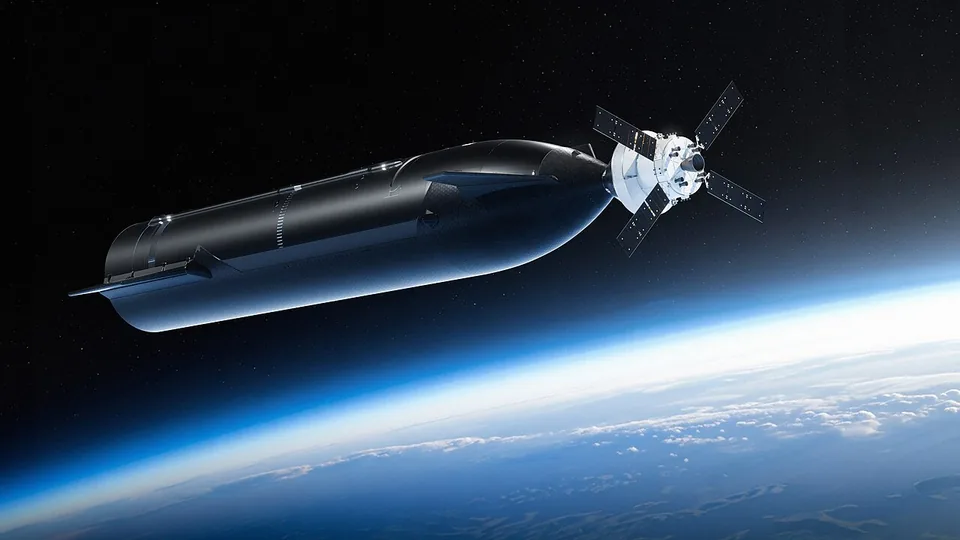
Artemis 3 evaluates two commercial lander architectures featuring distinct docking geometries and mission roles. The two docking campaigns show how Orion interfaces with two different commercial lander architectures in one mission.
| Feature | Blue Origin Blue Moon Mark 2 Test Article | SpaceX Starship Version 3 Test Article |
|---|---|---|
| Launch Location | Not specified in NASA sources | Florida |
| Orbital Altitude | Approximately 273 miles (237 nautical miles) | 206 nautical miles |
| Docking Interface | Port beside crew cabin | Forward-mounted docking system at the nose |
| Test Duration | Approximately 2 days docked | Up to 2 hours docked |
| Crew Ingress | Yes; astronauts enter and evaluate the cabin | No; external docking test only |
| On-Orbit Lifetime | Up to 30 days | Shorter on-orbit lifetime |
| Primary Objective | Habitation, life support, and cabin controls | Controllability, communications, and software |
The Blue Moon test article incorporates avionics, software, flight-control systems, crew-cabin hardware, and life-support functions planned for future lunar flights. In contrast, the Starship test evaluates controllability, communications, integrated software performance, and the dynamics of docking and undocking.
The Rocket Without an Upper Stage
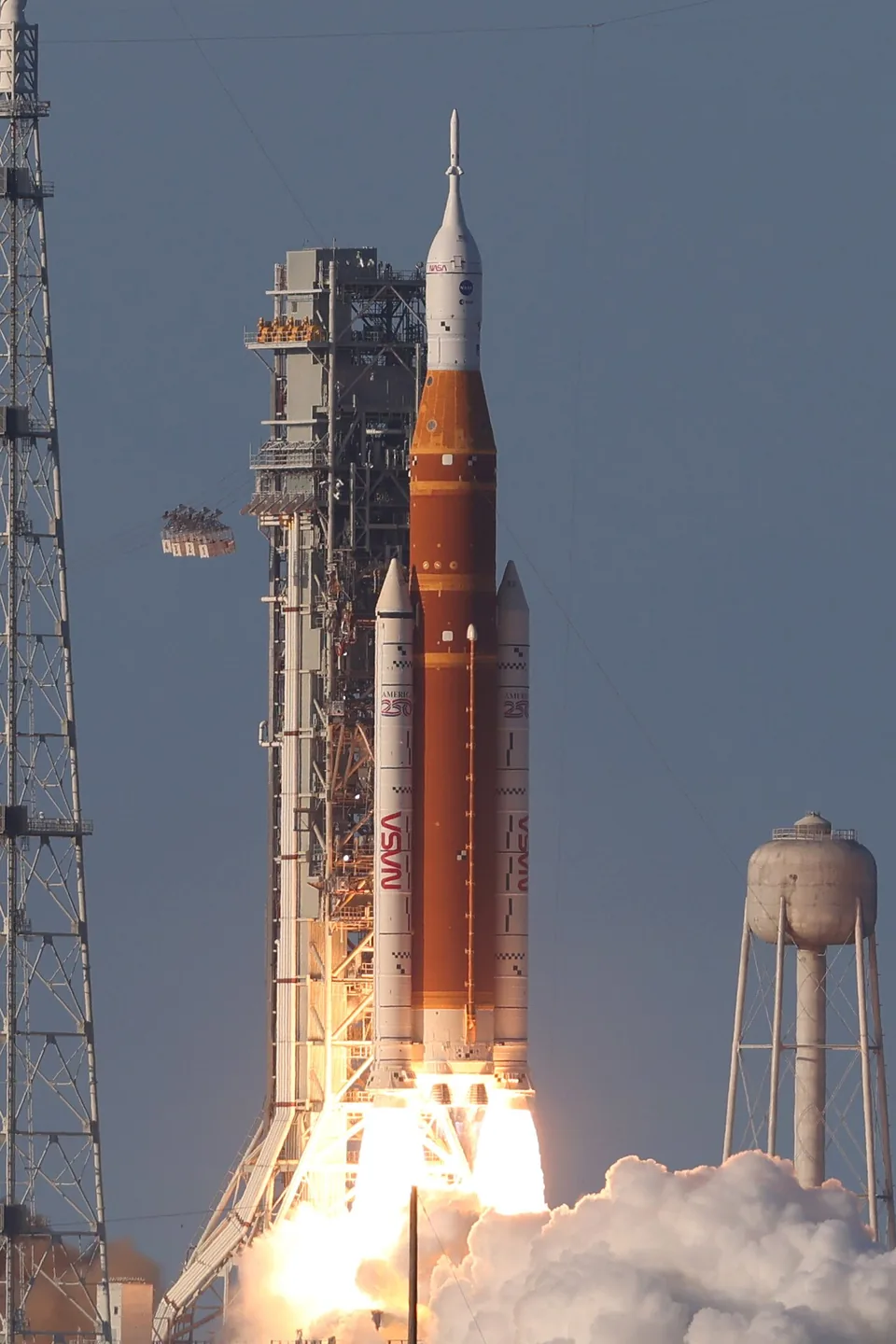
The SLS rocket launching Artemis 3 will fly without a propulsive upper stage. Instead of the interim cryogenic propulsion stage as the upper stage, NASA will use a non-propulsive spacer.
NASA will replace the upper stage with a structural spacer that matches the outer dimensions of the hardware it replaces. The spacer has the same dimensions and the same interface connection points between the Orion stage adapter and the launch vehicle stage adapter as the stage it replaces. As of May 2026, NASA’s Marshall Space Flight Center in Huntsville, Alabama, was designing and fabricating the spacer. On 12 May 2026, the Artemis 3 core stage was located in High Bay 2 of the Vehicle Assembly Building at Kennedy Space Center with the core stage tank attached to its engine section.
Low Earth orbit provides more launch opportunities for each flight element than a trajectory directed toward the Moon. The Deep Space Network will not be used. Instead, NASA has solicited input from commercial industry to improve ground communications during low Earth orbit operations. NASA also sought domestic and international interest in deploying CubeSats during the flight.
Other Test Objectives
Beyond lander docking tests, the crew has up to five days in orbit to conduct science and technology demonstrations. Astronauts will evaluate the Orion Crew Survival System suits, gather acoustic and thermal data, and assess human factors inside the capsule.
NASA planned several scientific and operational investigations:
- Autonomous health assessments: A proof-of-concept study evaluating how astronauts monitor their health when out of direct contact with ground controllers.
- Sample return protocols: Concepts for returning lunar samples to Earth: how future samples could be transported, received, and moved into curation facilities after landing, plus assessments of Orion’s environment for contamination considerations.
- Biological experiments: A cellular biology experiment, and plant seeds flying aboard Orion. Separately, several NASA-led investigations build on studies from Artemis 2.
- Earth and solar observations: The mission includes Earth and solar observations.
As of May 2026, NASA was looking at options to evaluate Axiom Space’s AxEMU spacesuit lander interfaces on Artemis 3, but the October 2026 NASA sources do not state whether those tests remain in the flight plan.
Why NASA Added Artemis III
NASA added this low Earth orbit demonstration flight to the Artemis program in a February 2026 announcement. NASA redefined Artemis III to demonstrate rendezvous and docking between test versions of landers and Orion in low Earth orbit. NASA’s lander development announcement for 2028 Moon missions confirmed that both lander providers are participating in Artemis 3 in low Earth orbit.
Under the agency’s original contracts, SpaceX’s Starship was assigned to Artemis 3 and Artemis 4, while Blue Origin’s Blue Moon was slated for Artemis V. Under the realigned framework, neither company is locked into a specific lunar landing flight. Instead, based on lander readiness, NASA will determine which company is first selected to deliver astronauts to the Moon’s surface in 2028, and a second crewed landing opportunity follows. Both companies must fly an uncrewed demonstration mission with their crewed landers before the crewed Moon missions, and NASA will certify lander systems beforehand.
NASA Administrator Jared Isaacman said NASA is executing to “complete the long-awaited return of American astronauts to the lunar surface in 2028 and establish a Moon Base.” Testing both landers in Earth orbit is designed to reduce risk, validate hardware, and gain operational experience before NASA attempts a crewed lunar landing.
The commercial providers are pursuing different architectures for future lunar flights:
- SpaceX: Plans to use orbital propellant aggregation. SpaceX plans to launch multiple Starships to low Earth orbit before Starship HLS launches; “tanker” Starships transfer propellant to a “depot” Starship that fuels the lander. SpaceX plans to demonstrate this propellant transfer during its uncrewed demonstration mission. Under the revised operations, Starship HLS would await Orion in Earth orbit, dock, then perform a trans-lunar injection burn to send the combined stack to low lunar orbit. NASA is working to modify Orion to enable this. The landers and Orion no longer rendezvous in a near-rectilinear halo orbit.
- Blue Origin: Defers orbital propellant transfer for its accelerated landing approach. Blue Origin plans to use three transfer stages to send the Blue Moon Mark 2 Alpha lander into an elliptical polar orbit around the Moon. The company has added hardware milestones and human-in-the-loop tests leading into the accelerated 2028 schedule.
What Is Still Unpublished
The NASA pages read for this article do not state several details of the Artemis 3 mission:
- The exact launch date, month, or targeted launch window in 2027.
- Launch times and specific launch pad assignments at Kennedy Space Center.
- Which crew members will command specific lander checkout tasks inside Blue Moon.
- Whether Axiom Space’s AxEMU spacesuit interfaces are part of the final flight plan.
- The precise date for SpaceX’s orbital propellant transfer demonstration.
Readers should check the official NASA Artemis III mission page or the NASA Artemis portal to verify updated schedules.